A financial district skyline at night
End-to-end AI advisory platform for financial consulting firms

From Client Financial Data to Clear Advice and Measurable Results

Trevanth.AI helps financial consulting firms manage the complete client advisory process in one place. It brings together financial records, analyses business performance, creates future forecasts and prepares practical recommendations. The platform automates repetitive data and reporting work, allowing advisors to spend more time guiding clients and measuring the results of their advice.

One client record

Ledgers, bank feeds, payroll, CRM and paperwork reconciled into a single dataset.

Evidence, not assertions

Every figure carries a confidence score and points back to the document or system feed it came from.

Expected vs realized

Each recommendation tracked from projected impact through to the value it returned.

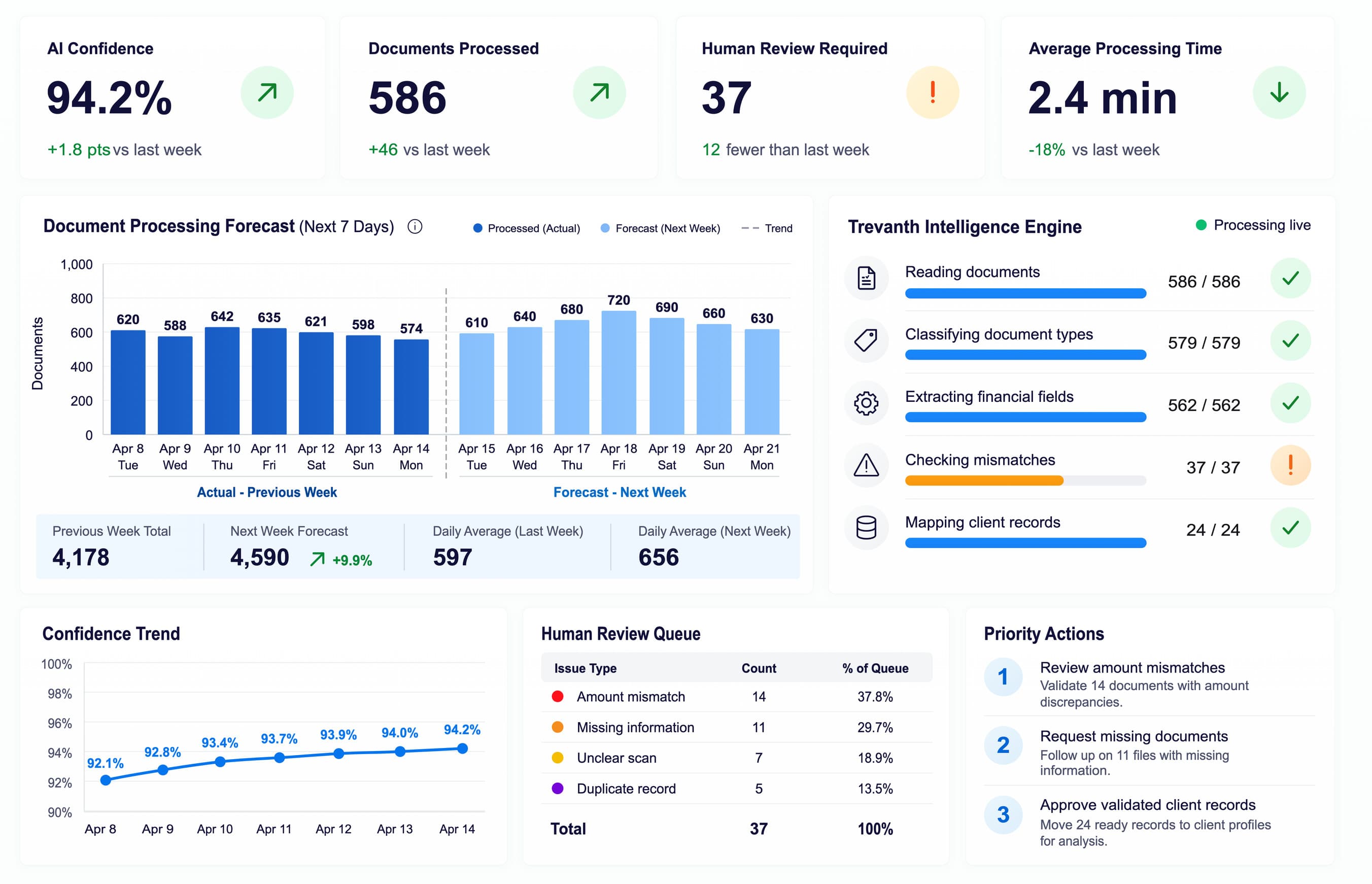
The dashboard

The whole extraction flow, on one screen.

100%

Field provenance

Every extracted field carries its source page, reviewer and confidence score — audit evidence, not a reconstruction job.

4 min

Packet to validated

From a packet landing to system-ready fields, instead of waiting in a pile for the next free desk.

11 hrs

Back to each consultant, weekly

Transcription and cross-system re-entry leave the workflow entirely.

0

Manual re-keys

Validated output is written straight into the CRM, tax platform and warehouse over their own APIs.

Modules

Multiple modules. One client record. One set of figures.

A client’s data enters once — ledgers, bank feeds, payroll, CRM, paperwork — and every module works from that one record. Each reads what the last one produced, so the board pack carries the figures the analysis ran on.

Start a conversation
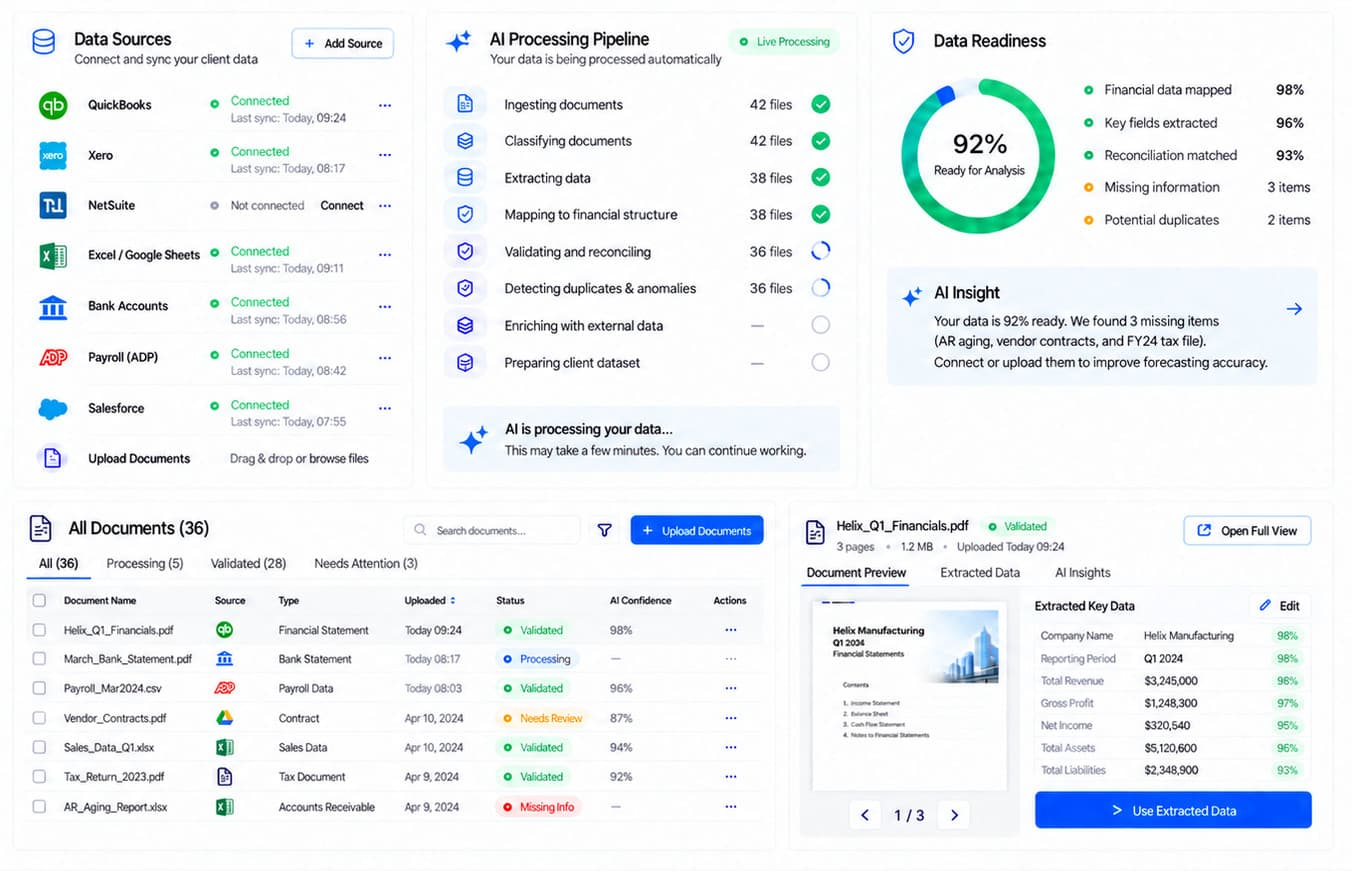
Module 01 — Client Intake and Data01/06

Turn Client Documents into Ready-to-Use Data

Client Intake and Data brings a client's financial records and documents together. AI reads the files, extracts key figures, and checks them against connected systems, reducing manual data entry. It flags missing or conflicting information for your team to review before analysis begins.
Module 02 — Financial Analysis02/06

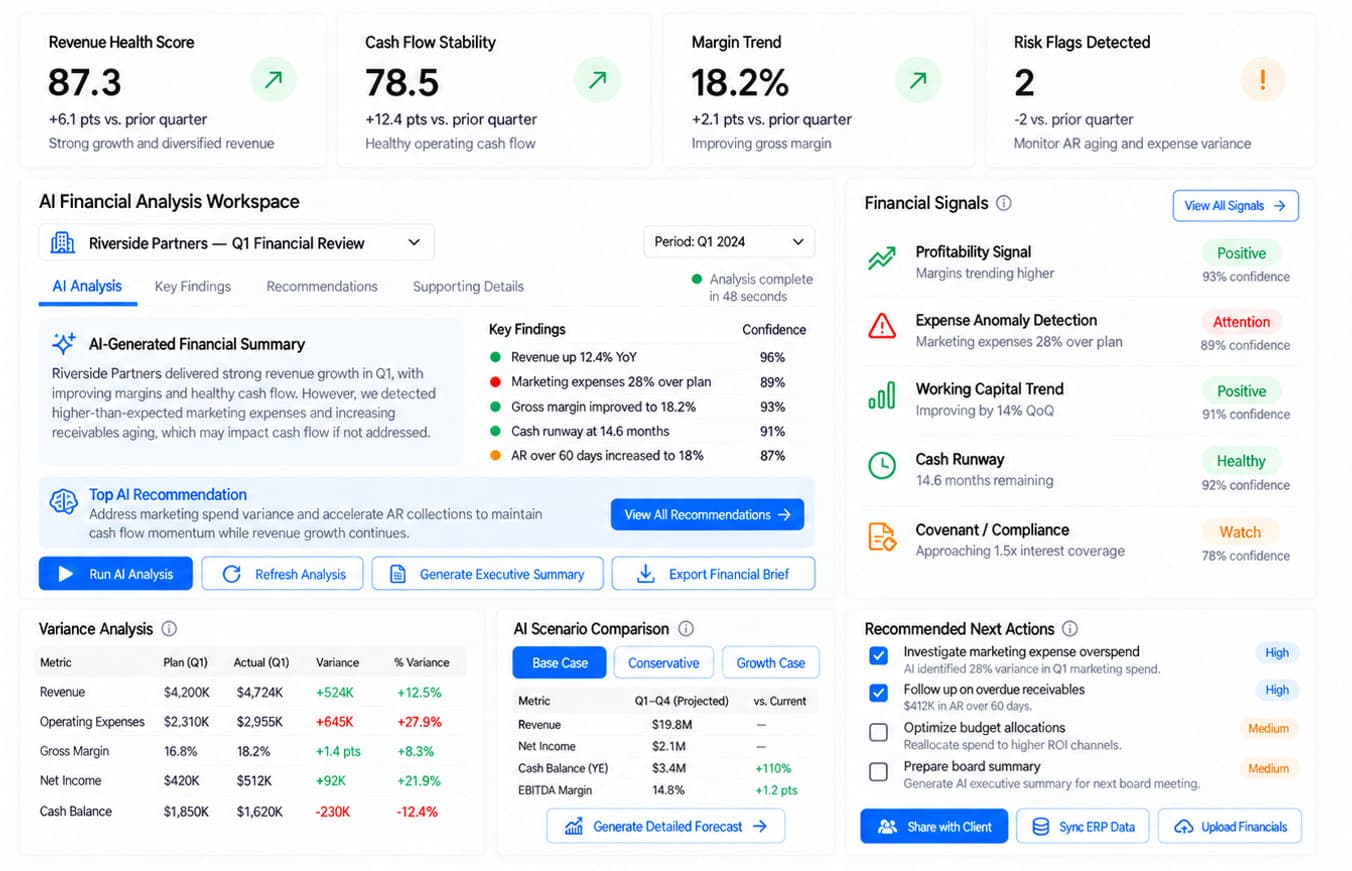
See the Full Financial Picture

See how your client's revenue, cash flow and profit margins have changed. The platform compares current results with past performance and financial plans, then highlights unusual movements and possible risks. AI prepares the key findings, giving advisors a clear starting point for the client conversation.

Module 03 — Forecast and Scenarios03/06

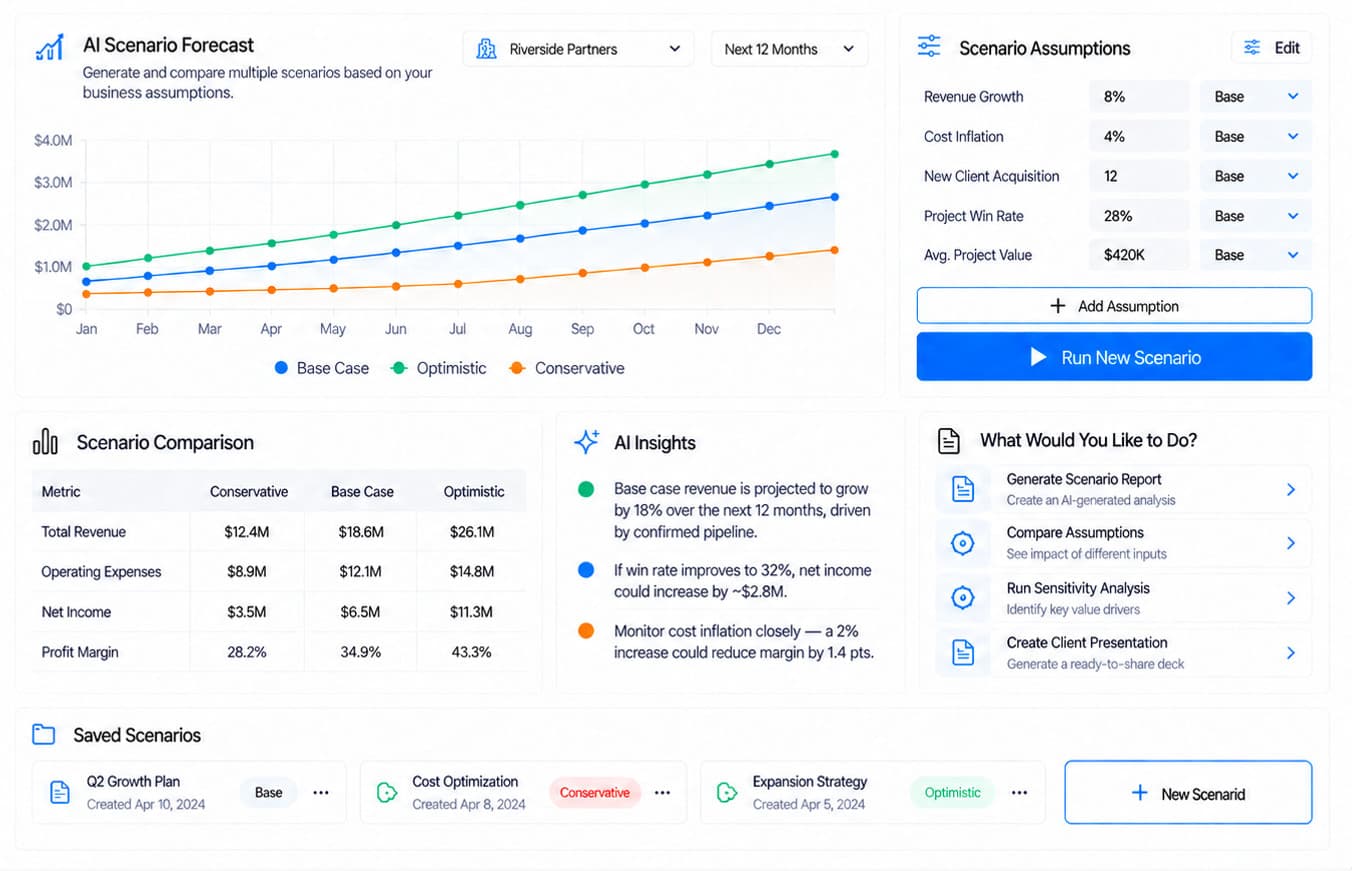
See How Business Changes Affect Future Finances

Forecast and Scenarios shows how a client's finances could change over the next 12 months. Adjust sales growth, costs or other assumptions, and the platform updates the forecast automatically. AI compares the possible outcomes and highlights what matters most, helping advisors discuss practical options with the client.

Module 04 — Advisory Recommendations04/06

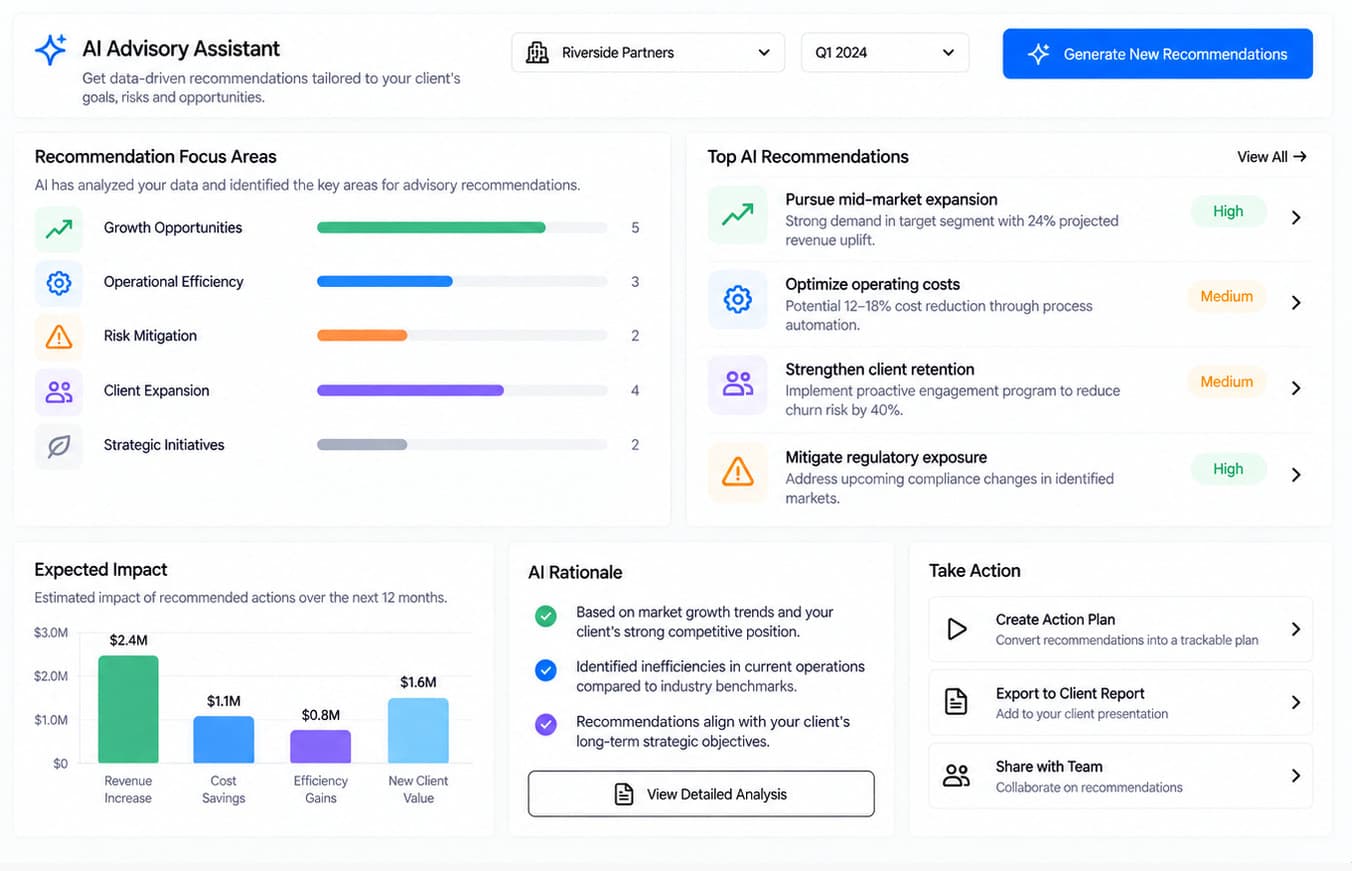
Identify the Best Actions for Each Client

Advisory Recommendations turns financial findings into suggested actions, such as reducing costs or improving client retention. AI ranks the options and estimates their possible impact using the client's data and forecasts. Advisors review the reasoning, choose what fits the client, and turn approved recommendations into an action plan.

Module 05 — Actions and Value Tracking05/06

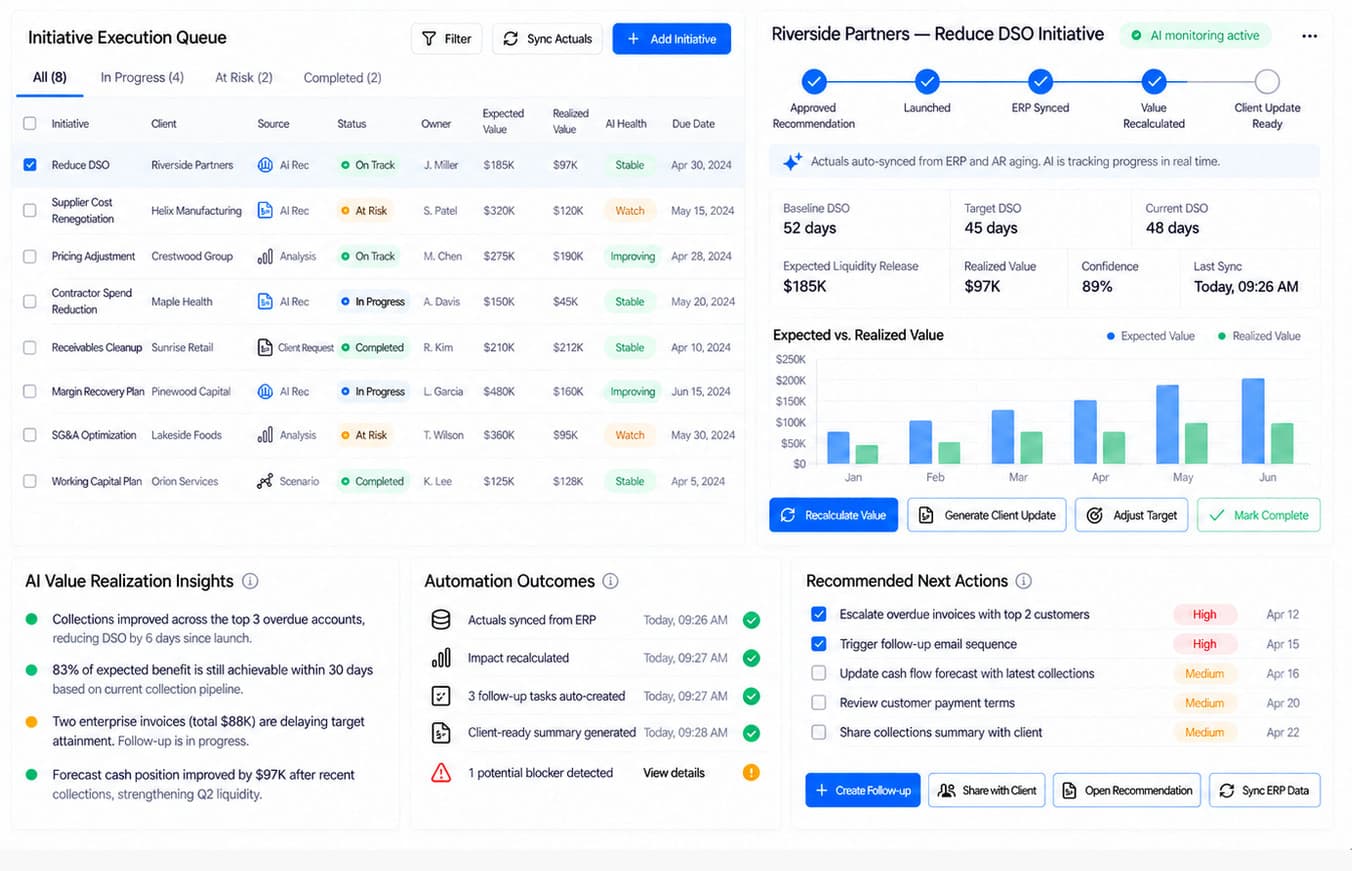
Track Client Actions and Measure Results

Once a client agrees on a recommendation, this module tracks who is responsible and what result is expected. The platform brings in updated figures and automatically compares actual results with the original target. AI flags actions that are falling behind, so advisors can follow up while there is still time to make a change.

Module 06 — Client Reports06/06

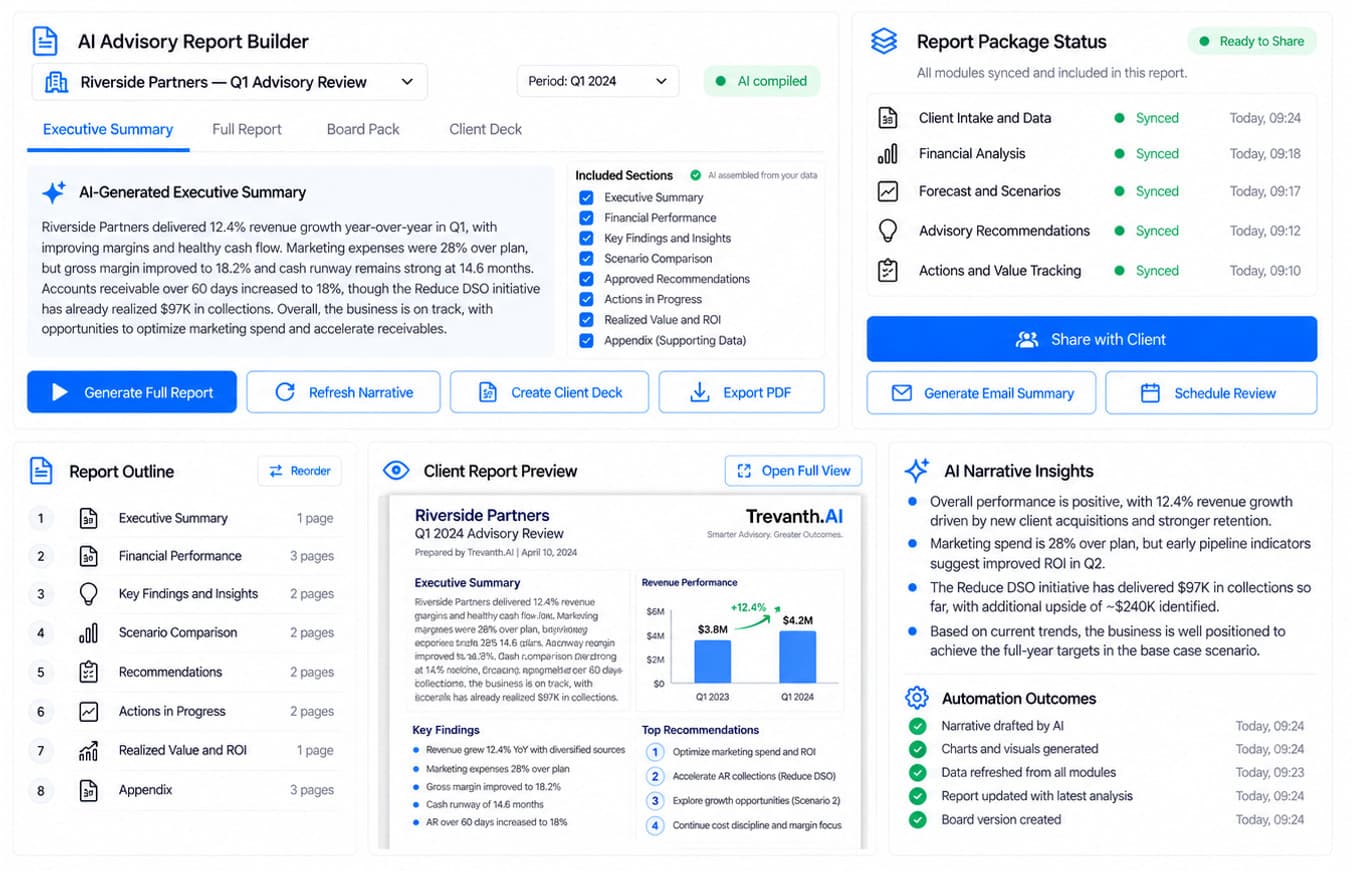
Turn Financial Findings into Client Reports

Client Reports brings the analysis, forecasts and agreed actions into one report. AI drafts the summary and creates charts using figures already in the client record, so your team does not have to copy them across by hand. Advisors review the report before sharing it with the client.

Approach

Where the real competition starts.

A clean record isn’t the finish line — it’s the fuel for the two things clients actually judge a firm on between engagements: how well it reads the market, and how fast it answers them. Trevanth.AI runs both off that same record, so nothing gets rebuilt by hand.

Discuss an engagement
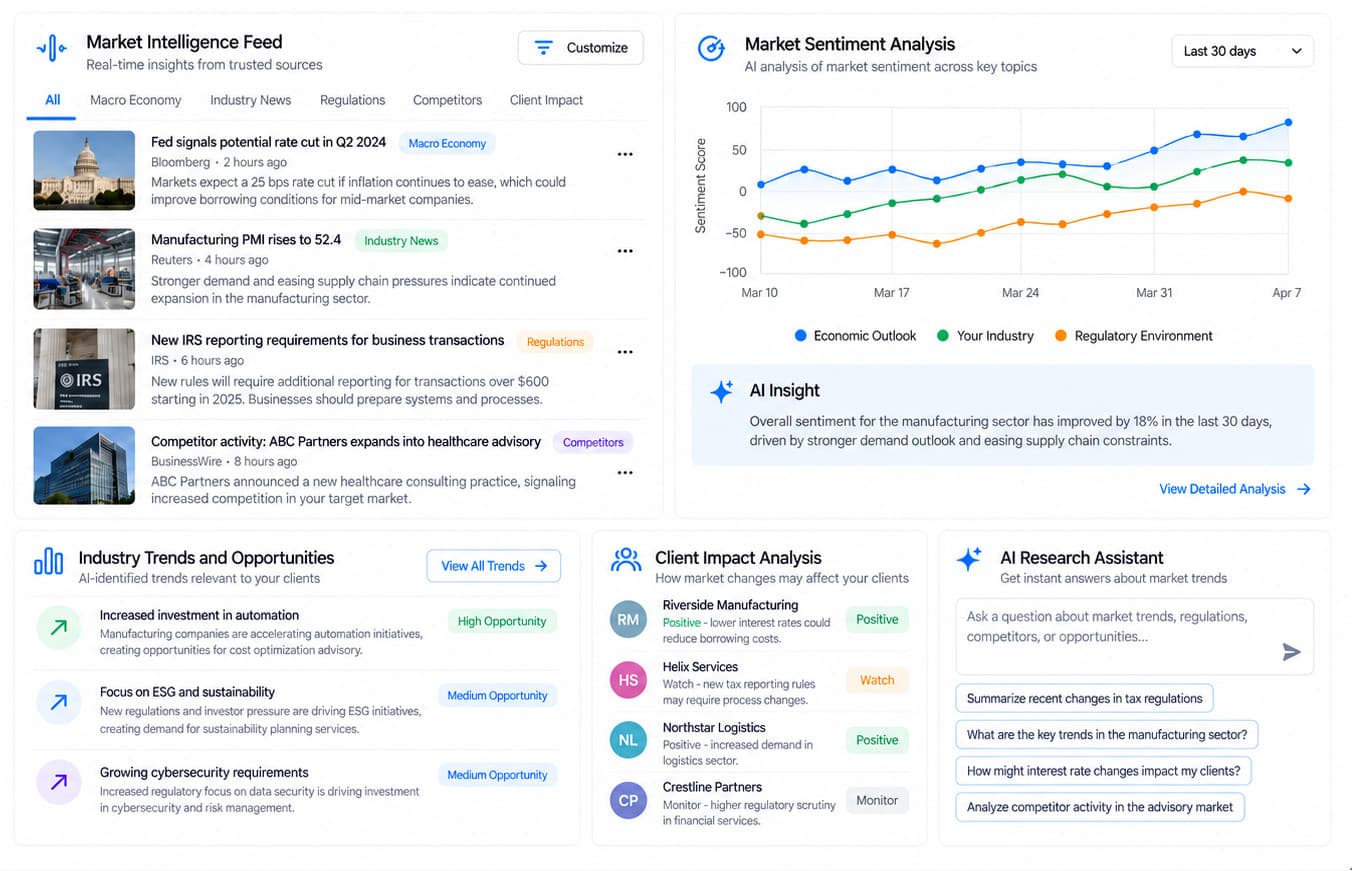
Market Sentiment and Intelligence01/02

Know what moved, and whose business it moves

The AI scores sentiment across macro, industry, regulatory and competitor sources, then maps each development onto the specific clients it touches.

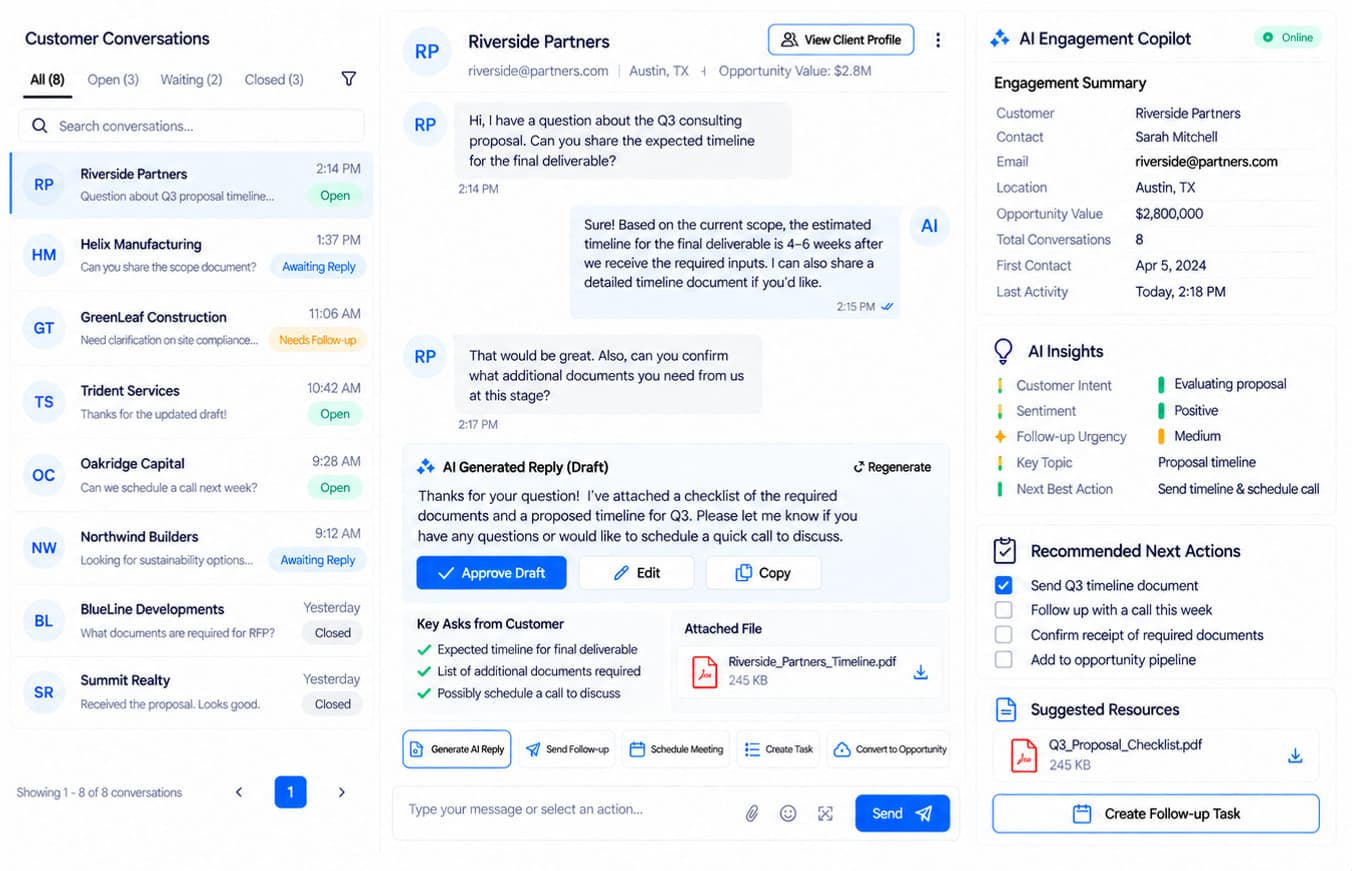
Customer Engagement Assistant02/02

AI replies at the same instant, from the record

The AI reads the incoming message, drafts a reply from the documents already on file, and scores intent and sentiment so follow-up goes where the work is live.

A consulting team reviewing client reporting at a whiteboard

The documents keep landing. The record should keep up.

Traditional SaaS vs Trevanth.AI

Don’t settle for the AI your software chose.

Most platforms ship one model and you work inside its limits. This one picks the best model for the work in front of you — and tells you which one ran it.

Traditional SaaS
Built-in
AI

One model, one pass, and no step you can point somewhere else.

You work within its limits.

Trevanth.AI · Routed extraction
01

Read the scanned packet

Layout-aware OCR holds the boxes, table rows and totals on a W-2 or a K-1 that a general model flattens into prose.

Document AILayout-aware OCR
02

Sort every page

A fine-tuned classifier tells a 1099 from a bank statement page by page, at a fraction of frontier cost.

Hugging FaceInference providers
03

Hold the whole packet at once

Long context keeps all forty pages in view, so a correction on page 9 still updates the figure it feeds on page 2.

GeminiLong-context frontier
04

Extract into your schema

Constrained decoding against a strict field schema, so the record never lands malformed in the ledger.

OpenAIStructured output
05

Reconcile against last year

A reasoning pass compares this year's figures against the prior return and surfaces only what actually moved.

ClaudeFrontier reasoning
06

Draft the deliverable

The summary is written from validated fields, every figure still carrying the page and line it came from.

MistralCost-efficient drafting

Note: Provider and model names describe the ecosystem an orchestration layer can route to. They are not a claim of partnership or endorsement, and not a statement that every model listed is enabled in a given workspace — the routing set is configured per deployment.

Compliance

The evidence your next examination asks for.

Trevanth.AI does not claim your obligations as its own. It produces the access records, field provenance and review trail that show an examiner you met them.

GLBA Safeguards Rule

Gramm-Leach-Bliley Act — Safeguards Rule (16 CFR Part 314)

Your firm is the regulated party here; Trevanth.AI is a service provider under §314.4(f). Access control, encryption in transit and at rest, activity logging and secure disposal are implemented so they can be written into your service agreement and assessed. And because every document is classified and extracted, the data inventory the rule requires is produced as a by-product of normal work.

IRC §7216

26 U.S.C. §7216 and §6713 — use and disclosure of tax return information

Tax return information may only be used to prepare the return unless the taxpayer consents in writing, and disclosure to a contractor — including any processing outside the United States — is restricted. Trevanth.AI records who touched which taxpayer record and when, and follows IRS Publication 4557 guidance through intake, processing and review.

Note: Listed for orientation only. These rules bind your firm rather thanTrevanth.AI, and supporting them in the product is not a substitute for your own counsel or compliance officer.

Connectivity

Built for the stack you already run.

QuickBooks, Xero, Salesforce, Snowflake, Power BI — and the rest of what your firm already runs on. 14 integrations — six core, eight optional — each one reached through the tool’s own documented public API rather than a scraper or a CSV drop.

Trevanth.AI integrations

Main integrations

  • QuickBooks Online
  • Xero
  • Microsoft 365 / Outlook
  • Google Workspace / Gmail
  • Salesforce Financial Services Cloud
  • HubSpot

Optional integrations

  • Box
  • Microsoft Power BI
  • Asana
  • Jira
  • Slack
  • Twilio
  • Snowflake
  • Google BigQuery

Note: Tool names and marks belong to their respective owners. No endorsement or partnership implied. Which connectors are enabled in a given workspace is confirmed during onboarding and scoped with your environment.

Nestack Agents — Financial Consulting Services

Your Financial Consulting AI agents, run like production systems.

Trevanth.AI runs on the Financial Consulting Services playbook inside Nestack Agents. Not chat windows bolted onto a dashboard — scoped agents with the firm’s documents, systems and review rules wired in, versioned and monitored like the rest of your stack.

  • ScopedAgents, not open chat
  • VersionedEvery prompt and tool
  • ReviewedHuman sign-off on output
  • LoggedEvery run, end to end

Pinned to the financial consulting agent playbook — not a generic agent checklist.

Add-ons

Add the hardware your workflow needs.

Most of what the platform reads still lands as paper on a consultant’s desk. Three device classes earn a place here — each with a supported way in, and a manual job it takes off that desk.

Sheet-fed desk scanner

Sheet-fed desk scanner

A compact duplex scanner that takes the stack off a consultant's desk — tax packets, bank statements and signed forms captured at 300 DPI in a single pass.

Chip and contactless ID reader

Chip and contactless ID reader

A desktop PC/SC reader that lifts verified identity fields straight off a client's chip-based ID card or passport instead of a consultant retyping them.

Handheld form barcode scanner

Handheld form barcode scanner

A pocket 1D/2D scanner for the control codes already printed on 1099s, K-1s, loan packets and the firm's own coversheets.

Note: Hardware, installation, and integration are not included in the standard subscription. Additional charges apply based on the hardware selected, integration modules required, and implementation scope.

Pricing

One firm. One number.

No per-document arithmetic, no module gates, no charge for the associate who only opens the review screen. The whole platform, one flat monthly subscription.

Subscription
$200/mo
Book a walk-through

One flat monthly figure for the whole platform, every module and every seat included. Onboarding is a separate one-time fee and any capture hardware is bought outright — see the Onboarding and Add-ons sections for both.

Note: AI API usage is charged separately. Clients must recharge their AI credit balance based on their usage.
  1. 01Every module on the platform, with no tiers
  2. 02Client intake with document extraction and confidence scores
  3. 03Financial analysis, variance and risk flagging
  4. 04Twelve-month forecasting across conservative, base and optimistic cases
  5. 05Ranked advisory recommendations, tracked from expected to realized value
  6. 06Drafted client reports, board packs and executive summaries
  7. 07Market sentiment mapped to your client book, and the engagement assistant
Onboarding

What your onboarding fee covers

A one-time setup that gets your firm live on Trevanth.AI — we ingest your document library, connect your intake channels, and configure the extraction lanes, review queues and audit trails. Each fee below is a starting point; the final scope and go-live date are agreed with you.

Essential

$1,000+one-time
  • Kickoff call and onboarding plan scoped to your client mix and document types
  • Workspace provisioning with partner, consultant and reviewer seats and roles
  • Ingest of your existing client and document records into the extraction layer
  • Extraction lanes configured for tax packets, statements, loan and onboarding forms
  • Email and secure client portal connected for inbound document capture
  • Review workflows, confidence thresholds and reviewer routing set to your house rules
  • Live-readiness check across a sample client packet before sign-off
  • Onboarding handbook and self-serve help for the team

Plus

Most firms
$2,500+one-time

Everything in Essential, plus:

  • Guided migration of historical client documents and audit trails, with validation
  • Two integrations — CRM, practice management or accounting system — connected and field-mapped
  • Retention, access and disposal settings configured to support your GLBA Safeguards and §7216 obligations
  • Custom deliverable templates for advisory memos, review packs and client reports
  • Live training session for consultants and reviewers, with a recording
  • Dedicated onboarding specialist for the rollout

Enterprise

$5,000+one-time

Everything in Plus, plus:

  • Tailored implementation across multiple offices, practices or client portfolios
  • Bespoke integrations and SSO across your document store, CRM and tax platform
  • Bulk migration of client history and prior-year packets, with cleansing and reconciliation
  • Role-based training tracks for consulting, compliance and delivery teams
  • Reporting workflows aligned to your engagement calendar and client review cadence
  • Named onboarding manager with a defined go-live date
Where it runs

Two ways to deploy — same platform, same subscription

Run Trevanth.AI wherever your client documents, tax packets and engagement records are allowed to live. The subscription figure is identical either way.

Cloud (SaaS)

Runs in Nestack’s managed cloud — nothing to provision. The fastest way to get your firm live and processing client documents.

Private / self-hosted

The same platform deployed inside your own infrastructure — your cloud, VPC or on-prem — for firms with strict data mandates. Client packets, taxpayer records and PII stay in your environment; where a step would otherwise route to a hosted model provider, it is configured against models running inside that boundary instead. The routing set is agreed in writing at go-live, and the subscription stays the same.

FAQs

Frequently asked questions

What it costs, what happens when the AI is wrong, how it sits with your §7216 and GLBA obligations, and who is on the other end once you have signed. If something you need to know is not here, ask it on the call.

Connect with our team
What am I actually paying for each month?

One flat monthly subscription for the whole firm — the full platform, every seat. The partner signing off, the consultant working the extraction and the associate who only ever opens the review queue all cost the same: nothing extra. There are no tiers to climb and nothing held back for an upgrade conversation. Onboarding is billed once and separately, and capture hardware is optional and separate again.

No. The subscription is flat, so a February packet surge does not arrive as a surprise invoice in March. Volume is precisely what breaks per-document pricing — the meter runs hardest in the weeks you can least afford it — and that is the model we deliberately did not build.

Because the setup is real work, and we would rather price it in the open than fold it into a headline rate. It covers ingesting your existing client and document records, configuring extraction lanes for your document mix, setting confidence thresholds and reviewer routing to your house rules, and a live-readiness check against a sample client packet before anyone signs it off. It starts at $1,000 and rises with migration depth, integrations and training — the three tiers are set out above.

Yes, and we would rather you did. Book a walk-through and we will run Trevanth.AI against a slice of your real client packets before the first call, so the first thing you look at is your own paperwork rather than a demo tenant full of somebody else's numbers.

It gets held, not passed through. Every extracted field carries a confidence score and points back to the page and line it was read from, and anything below the threshold you set goes to a named reviewer instead of onward. The failure we designed against is a wrong number arriving quietly inside a deliverable with nothing to trace it back to.

Your firm is the regulated party and we are a service provider under §314.4(f), so the controls are built to be contracted and assessed: access control, encryption in transit and at rest, activity logging and secure disposal, with retention and access settings configured during onboarding. Tax return information is handled to §7216 and IRS Publication 4557. We do not hold a SOC 2 Type II report — if you need one in hand before signing, raise it on the call.

A document store holds the file. This reads it. Fields come out scored and sourced, get validated and reconciled against what the same client filed before, then carry through to the advisory work you bill for — and back out into QuickBooks, Xero, NetSuite or your CRM over their own APIs. If the honest answer to “what was this client’s gross margin last quarter” is still “open the PDF”, that is the gap.

Most firms feel it in the first engagement cycle, not the first quarter. The associate hours lost to document chasing, the consultant day spent rebuilding pivot tables, the senior advisor side-calculations before a client meeting — those are the costs you are already carrying. When a packet reconciles overnight instead of over a week, and the board pack pulls from the same record the analysis ran on, the subscription stops looking like software spend and starts looking like capacity you stopped leaking.

With their numbers, not your assurance. Every recommendation you put in front of a client is tracked from expected impact through to realized value, with actuals synced back from their own ERP, and the client report is assembled from that same record. When a client asks what your advice actually returned, you answer with evidence.

It takes away a job they already resent rather than adding one they have to remember. Nobody is asked to log in and do extra keying — the queue a consultant opens holds the exceptions, and everything above threshold has already moved on without them. Onboarding sets thresholds and routing to the way your firm already reviews work, so week one looks like your existing process with the retyping removed.

Onboarding runs to a plan scoped on a kickoff call. Essential covers workspace provisioning, extraction lanes, review workflows and a handbook for the team. Plus adds guided migration of historical documents and audit trails, two connected integrations, a live training session with a recording, and a dedicated onboarding specialist. Enterprise adds role-based training tracks across consulting, compliance and delivery, and a named onboarding manager working to a defined go-live date.

Book a demo

See it on the work you actually do.

Take a time, tell us who you are, then pick the screens you want to see. We’ll walk Trevanth.AI through sample packets of the type your firm handles — and if you bring a redacted packet of your own, we’ll run that live with you.